

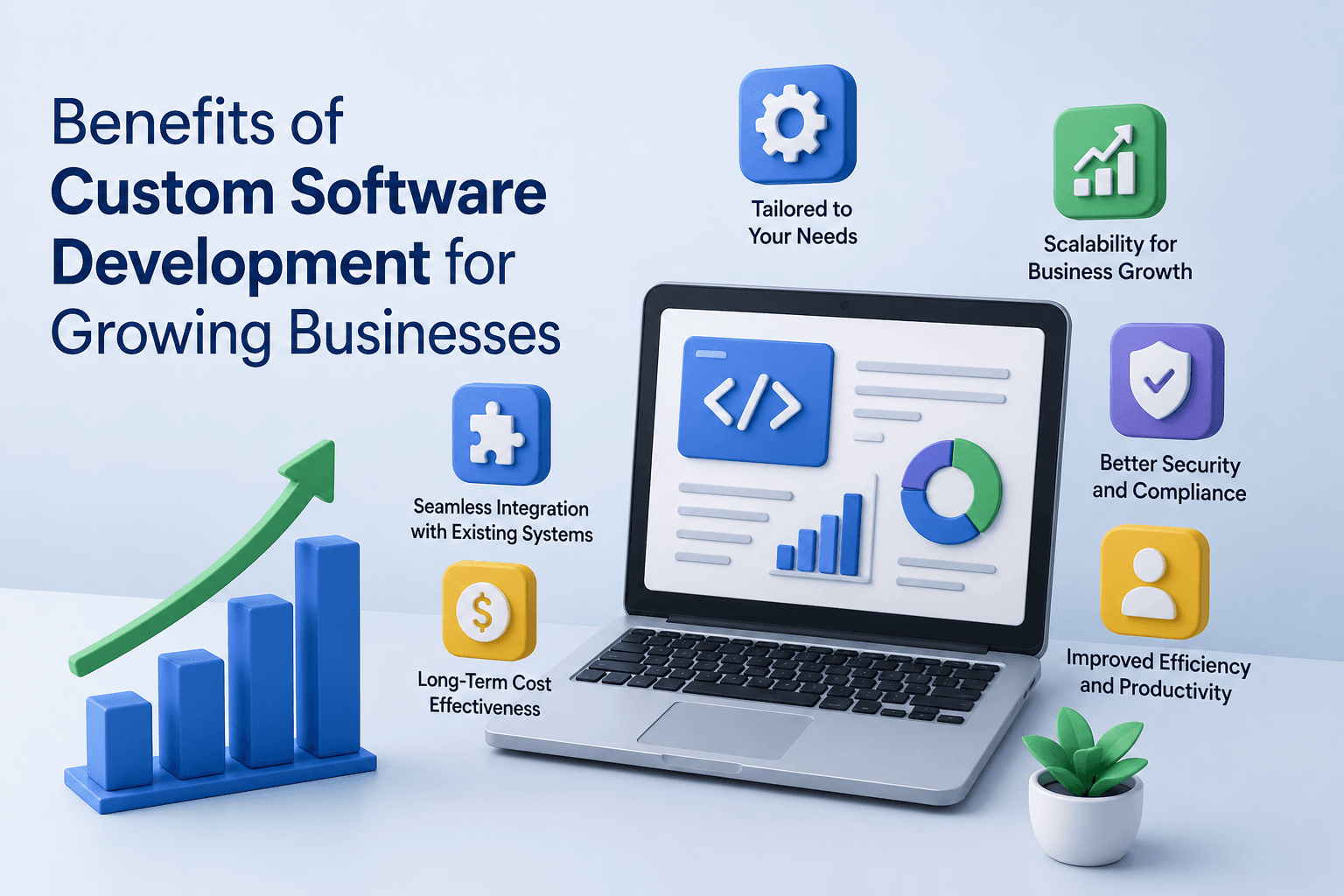
Benefits of Custom Software Development for Growing Businesses
Introduction
Many growing businesses reach a point where standard software can no longer support their operations effectively. As customer demands increase and internal processes become more complex, organizations often struggle with tools that were not designed for their specific workflows.
This challenge is becoming more common across the USA and UAE. Companies need flexible systems that adapt to their business model instead of forcing teams to adjust their processes around software limitations.
Custom Software Development offers a practical solution. It allows businesses to create technology that aligns with their goals, improves efficiency, and supports future growth. Unlike off-the-shelf products, Custom Software Development Solutions are built to address unique business requirements and provide long-term value.
Why This Matters
As organizations expand, technology becomes a critical factor in maintaining operational efficiency and customer satisfaction.
- Supports unique business processes and workflows
- Improves productivity through automation
- Reduces dependency on multiple disconnected tools
- Enhances data security and compliance
- Provides scalability for future business growth
Understanding Custom Software Development
Tailored Solutions for Unique Business Needs
Every organization operates differently. Generic software often includes unnecessary features while missing critical functionality. Custom Software Development focuses on creating solutions that align directly with business objectives.
Organizations can design workflows, dashboards, reporting systems, and integrations that match their operational requirements. This approach improves efficiency while reducing employee frustration.
Key Points
- Designed around specific business requirements
- Eliminates unnecessary software features
- Supports industry-specific processes
- Improves operational control
Example / Use Case
A logistics company may require specialized shipment tracking and route optimization features. A custom solution can integrate these capabilities into a single platform, improving visibility and reducing operational delays.
Better Integration Across Systems
Many growing businesses use multiple software platforms for finance, customer management, operations, and communication. Managing disconnected systems often creates inefficiencies and data inconsistencies.
Custom Software Development Solutions help connect these platforms through seamless integrations. Teams can access accurate information without switching between multiple applications.
Key Points
- Connects existing business applications
- Improves data accuracy
- Reduces manual data entry
- Creates a unified operational environment
Example / Use Case
A retail company can integrate its inventory management system, CRM, and accounting software into a centralized platform. This improves reporting accuracy and simplifies daily operations.
Scalability for Long-Term Growth
Software requirements change as businesses grow. Many off-the-shelf platforms become restrictive when organizations need additional features, users, or workflows.
Custom solutions are designed with scalability in mind. New functionality can be added without disrupting existing operations, allowing businesses to evolve without replacing entire systems.
Key Points
- Supports business expansion
- Accommodates increasing user demands
- Allows feature enhancements over time
- Reduces future migration costs
Example / Use Case
A startup may begin with a simple customer portal and later expand it into a complete business management platform without rebuilding the system from scratch.
Improved Security and Compliance
Cybersecurity concerns continue to increase across industries. Generic software often becomes a target because vulnerabilities affect a large number of users simultaneously.
Custom applications provide greater control over security measures and compliance requirements. Organizations can implement security policies tailored to their industry standards.
Key Points
- Enhanced data protection
- Industry-specific compliance support
- Controlled access management
- Reduced exposure to common threats
Example / Use Case
Healthcare providers handling sensitive patient information can implement specialized security protocols and compliance features that align with regulatory requirements.
Key Benefits
- Increased operational efficiency
- Better customer experiences
- Enhanced business flexibility
- Reduced reliance on multiple software tools
- Stronger data security controls
- Improved scalability and performance
- Faster decision-making through customized reporting
- Greater competitive advantage
Common Mistakes
- Choosing the lowest-cost development option without evaluating quality
- Ignoring scalability requirements during planning
- Failing to involve end users in requirement gathering
- Overcomplicating the initial software scope
- Neglecting ongoing maintenance and support
- Not prioritizing cybersecurity from the beginning
Future Trends
The future of Software Development is increasingly driven by artificial intelligence, automation, and cloud-native architectures. Businesses are seeking solutions that can adapt quickly to changing market conditions while maintaining operational efficiency.
Custom Software Development Solutions will continue incorporating AI-powered analytics, predictive insights, and intelligent automation capabilities. Organizations investing in tailored software today will be better positioned to leverage emerging technologies tomorrow.
Additionally, low-code integrations, cloud-based infrastructure, and advanced cybersecurity frameworks will become standard components of modern business applications. Companies that embrace these innovations can improve agility while supporting long-term digital transformation goals.
Conclusion
Growing businesses need technology that evolves alongside their operations. Standard software may work during the early stages, but expansion often exposes limitations that reduce efficiency and hinder innovation.
Custom Software Development provides the flexibility, scalability, and security required for sustainable growth. By investing in tailored solutions, organizations can improve productivity, enhance customer experiences, and build a stronger competitive position.
If your business is planning its next stage of growth, explore how MatchBest Software can help deliver customized technology solutions designed around your unique requirements. You can also discover additional Innovative Solutions to accelerate your digital transformation journey.
FAQ Section
1. What is Custom Software Development?
Custom Software Development involves creating software specifically designed to meet the unique requirements of a business rather than using standard commercial applications.
2. Is custom software suitable for small businesses?
Yes. Small businesses can benefit from customized solutions that improve efficiency, automate tasks, and support future growth without paying for unnecessary features.
3. How long does a custom software project take?
Project timelines depend on complexity, functionality, and integration requirements. Simple solutions may take a few months, while enterprise systems can require longer development cycles.
4. Is custom software more secure than off-the-shelf software?
Custom applications often provide stronger security controls because they can be designed around specific business requirements and compliance standards.
5. What industries benefit most from custom software?
Industries such as healthcare, finance, logistics, manufacturing, retail, and professional services frequently benefit from customized software solutions.
Latest Article
AI Chatbots vs Human Support for Better Customer Experience
Previous Blogs
Why ERP Modernization Is Essential for Business Growth in 2026
Author
Written by: Andrew