

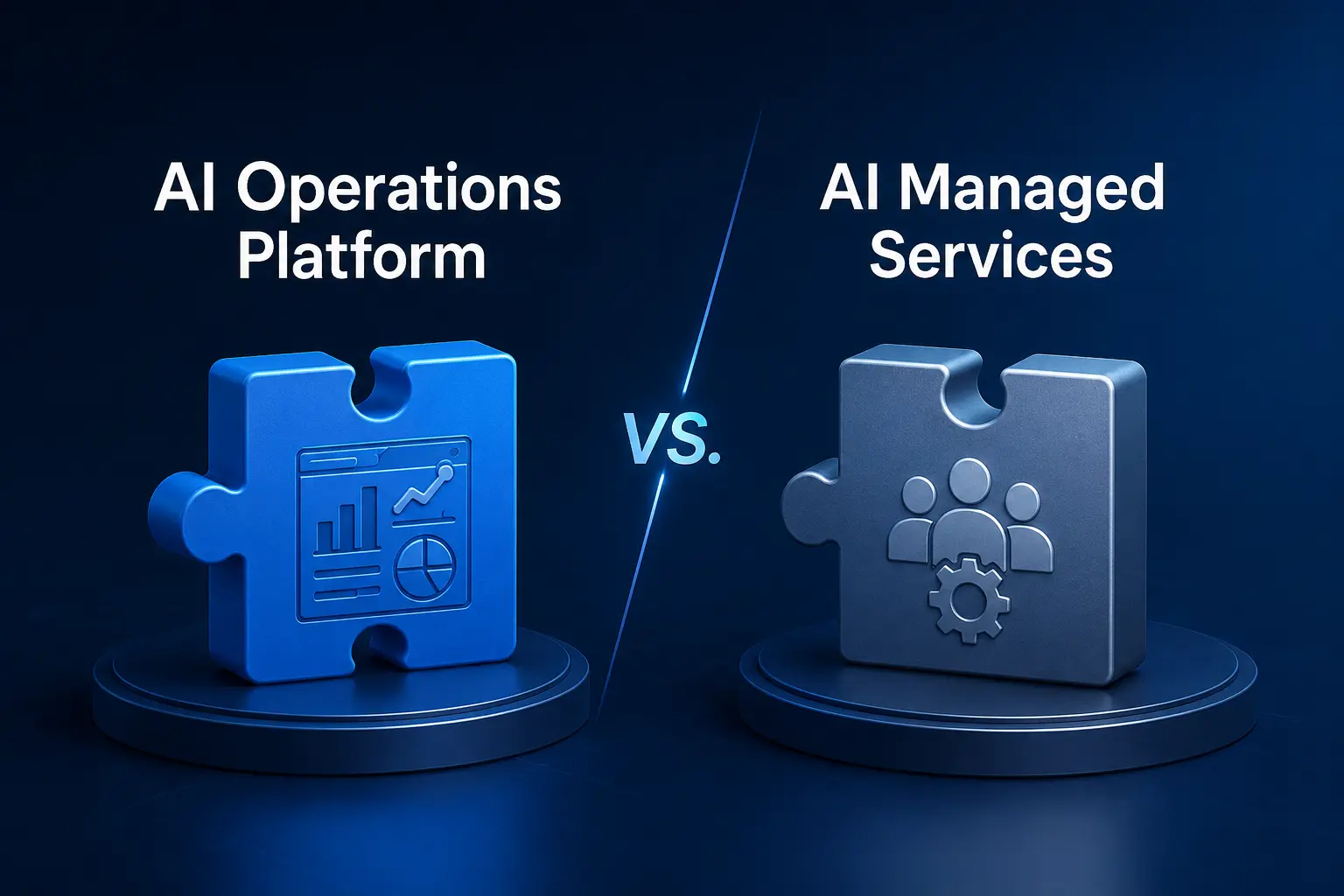
AI Operations Platform vs. AI Managed Services: What's the Difference?
Artificial intelligence has become a core component of modern business operations. As organizations increasingly adopt AI technologies, many decision-makers encounter two common terms: AI Operations Platform and AI Managed Services.
While both solutions help businesses leverage AI effectively, they serve different purposes. An AI Operations Platform provides the tools and infrastructure needed to manage AI systems internally, while AI Managed Services offer expert support for businesses that prefer outsourcing AI operations and maintenance.
Understanding the differences between these approaches is essential for selecting the right strategy for your organization. In this guide, we'll compare AI Operations Platforms and AI Managed Services, examine their advantages, and help you determine which option best aligns with your business goals.
What Is an AI Operations Platform?
An AI Operations Platform is a centralized system that enables organizations to develop, deploy, monitor, manage, and optimize AI models and workflows at scale.
These platforms help businesses streamline AI operations while maintaining control over their infrastructure and processes.
Common capabilities include:
- AI model deployment
- Performance monitoring
- Data pipeline management
- Workflow automation
- Predictive analytics
- Security and governance controls
- Real-time reporting
- Resource optimization
An AI Operations Platform acts as the operational backbone for organizations running multiple AI applications across departments.
Businesses implementing AI platforms often combine them with broader Digital Transformation Services to modernize workflows and improve operational efficiency.
What Are AI Managed Services?
AI Managed Services involve outsourcing the management, maintenance, optimization, and monitoring of AI systems to an experienced technology partner.
Instead of building an internal AI operations team, organizations rely on specialists to handle technical complexities and ongoing support.
Typical AI Managed Services include:
- AI infrastructure management
- Model monitoring and optimization
- Performance tuning
- Security management
- Compliance support
- Incident response
- Continuous updates
- AI strategy consulting
This approach allows businesses to focus on core operations while experienced professionals manage the technical aspects of AI deployment.
Key Differences Between AI Operations Platforms and AI Managed Services
Although both approaches support AI adoption, they differ significantly in ownership, management, and resource requirements.
| Feature | AI Operations Platform | AI Managed Services |
|---|---|---|
| Infrastructure Ownership | Internal | Provider Managed |
| Operational Control | High | Shared or Outsourced |
| Internal Expertise Required | Significant | Minimal |
| Setup Responsibility | Business Team | Service Provider |
| Ongoing Monitoring | Internal Team | Managed Service Partner |
| Customization | Extensive | Moderate to High |
| Scalability | High | High |
| Cost Structure | Platform Licensing | Subscription or Service-Based |
The right choice depends on your organization's technical capabilities, budget, and long-term AI strategy.
Benefits of an AI Operations Platform
Organizations with dedicated technical teams often prefer AI Operations Platforms because they provide greater control and flexibility.
Greater Operational Control
Businesses maintain full ownership of AI systems, data, and deployment processes.
Faster Innovation
Internal teams can experiment, iterate, and deploy new AI models without relying on external providers.
Enhanced Customization
AI platforms can be tailored to specific business workflows and operational requirements.
Improved Visibility
Centralized dashboards provide real-time insights into AI performance, resource utilization, and business outcomes.
Long-Term Cost Efficiency
For organizations with large-scale AI initiatives, platform-based operations may become more cost-effective over time.
Benefits of AI Managed Services
Many organizations choose AI Managed Services because they reduce complexity and accelerate implementation.
Access to Specialized Expertise
Businesses gain access to experienced AI engineers, data scientists, and infrastructure specialists.
Reduced Operational Burden
Internal teams can focus on business objectives rather than platform management.
Faster Deployment
Managed service providers often have established frameworks that speed up implementation.
Continuous Optimization
Providers monitor AI systems, identify performance issues, and implement improvements proactively.
Predictable Costs
Subscription-based pricing often makes budgeting easier compared to building internal AI operations teams.
When Should Businesses Choose an AI Operations Platform?
An AI Operations Platform is often the better choice when:
- The organization has an experienced technical team.
- AI is a core business capability.
- Multiple AI applications require centralized management.
- Data governance requires internal control.
- Long-term AI investments are a strategic priority.
Large enterprises, technology companies, and organizations with mature AI programs often benefit most from platform-based operations.
When Should Businesses Choose AI Managed Services?
AI Managed Services are often ideal when:
- Internal AI expertise is limited.
- Faster deployment is required.
- Operational resources are constrained.
- Businesses prefer predictable costs.
- Continuous expert support is needed.
Small and mid-sized organizations frequently use managed services to accelerate AI adoption without building large in-house teams.
Buying Guide: How to Choose the Right Solution
Before selecting an AI Operations Platform or AI Managed Services provider, evaluate the following factors.
Technical Resources
Determine whether your team has the expertise required to manage AI infrastructure and workflows internally.
Business Objectives
Clarify whether your goal is operational control, rapid implementation, or long-term scalability.
Budget Considerations
Compare:
- Initial implementation costs
- Ongoing operational expenses
- Staffing requirements
- Training investments
Compliance Requirements
Organizations in healthcare, finance, and regulated industries should ensure solutions support necessary compliance standards.
Businesses seeking highly customized AI environments often work with a specialized Custom Software Development Company to align technology investments with operational goals.
Expert Advice for Business Leaders
The decision between an AI Operations Platform and AI Managed Services should not be based solely on technology preferences.
Start by assessing your organization's readiness for AI at scale.
Consider:
- Available technical talent
- Internal infrastructure capabilities
- AI maturity level
- Long-term strategic goals
- Budget flexibility
Many successful organizations begin with managed services and transition to a dedicated AI Operations Platform as their AI programs mature.
This phased approach reduces risk while enabling sustainable growth.
For additional industry guidance, business leaders can explore resources from IBM AI and Microsoft AI.
Why Businesses Partner with Matchbest Software
At Matchbest Software, we help organizations evaluate, implement, and optimize AI solutions based on their unique business requirements.
Our expertise includes:
- AI Operations Platform implementation
- AI Managed Services
- Enterprise AI integration
- Custom software development
- AI workflow automation
- Performance optimization
We work closely with businesses to identify the most effective approach, whether that involves building a scalable AI operations environment or leveraging managed services for faster adoption.
Our goal is to help organizations maximize AI investments while maintaining flexibility for future growth.
Frequently Asked Questions
What is an AI Operations Platform?
An AI Operations Platform is a centralized environment used to deploy, monitor, manage, and optimize AI models and workflows across an organization.
What are AI Managed Services?
AI Managed Services involve outsourcing AI operations, maintenance, monitoring, and optimization to a specialized service provider.
Which option is more cost-effective?
The answer depends on scale. Smaller organizations often find managed services more affordable, while larger enterprises may achieve long-term savings through platform ownership.
Can businesses use both approaches?
Yes. Many organizations combine an AI Operations Platform with managed services for monitoring, optimization, or specialized support.
Which solution offers greater control?
AI Operations Platforms provide significantly more operational control because infrastructure and workflows remain under internal management.
Which option is best for growing businesses?
Businesses with limited AI expertise often benefit from managed services initially and can transition to a platform-based approach as requirements evolve.
Conclusion
Both AI Operations Platforms and AI Managed Services play important roles in modern AI strategies. An AI Operations Platform provides greater control, customization, and scalability, while AI Managed Services offer expert support, reduced complexity, and faster implementation.
The right choice depends on your organization's technical capabilities, business objectives, budget, and long-term vision. By evaluating these factors carefully, businesses can build an AI strategy that supports growth, innovation, and operational efficiency.
Whether you're exploring AI for the first time or expanding existing capabilities, Matchbest Software can help you choose and implement the solution that delivers the greatest business value.