

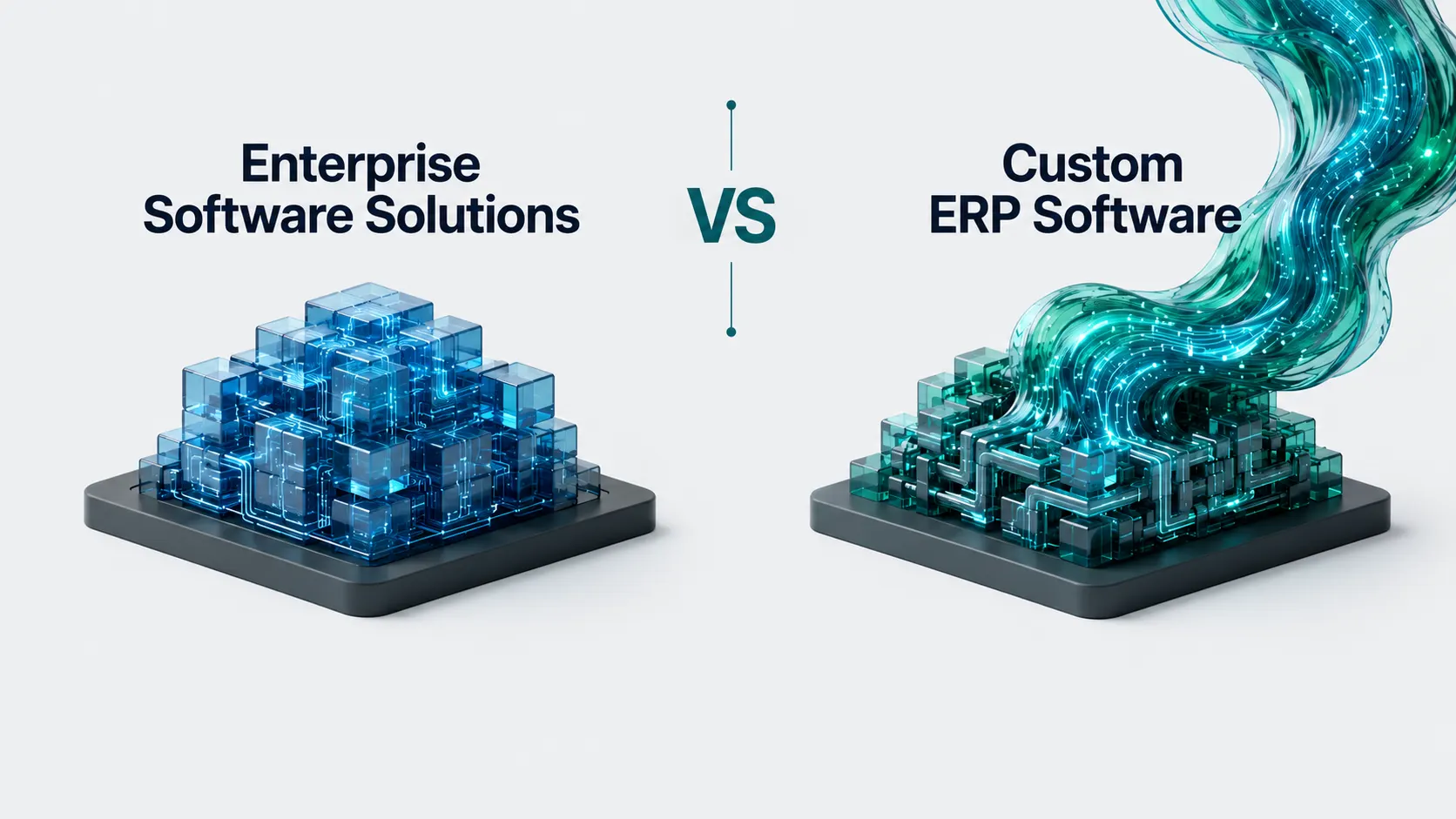
Enterprise Software Solutions vs Custom ERP Software: Which Is Right for Your Business?
Introduction
Businesses today rely heavily on digital systems to streamline operations and improve productivity. As organizations grow, they often face an important decision between adopting enterprise software solutions or investing in custom ERP software tailored to their specific needs.
Both options offer valuable advantages, but choosing the right approach depends on business goals, budget, scalability requirements, and operational complexity. Understanding the differences can help decision-makers avoid costly mistakes and maximize technology investments.
Modern enterprises across the USA and UAE increasingly seek flexible technology platforms that support automation, data visibility, and long-term growth. This is where evaluating enterprise application services and software product engineering strategies becomes essential.
Why This Matters
Selecting the wrong software platform can lead to inefficiencies, increased costs, and limited scalability. The right solution helps businesses improve workflows, enhance collaboration, and support future expansion.
Key reasons this decision matters:
- Improves operational efficiency across departments
- Supports business growth and scalability
- Reduces manual processes and data silos
- Enhances reporting and decision-making
- Maximizes return on technology investments
Understanding Enterprise Software Solutions
What Are Enterprise Software Solutions?
Enterprise software solutions are pre-built platforms designed to manage various business functions such as finance, human resources, customer management, supply chain operations, and analytics. These systems are developed to serve a wide range of industries and organizations.
Organizations often choose enterprise solutions because they offer faster deployment, proven functionality, and ongoing vendor support.
Key Points
- Ready-to-use business applications
- Faster implementation timelines
- Lower initial development costs
- Vendor-managed updates and maintenance
- Industry-standard best practices included
Example / Use Case
A retail company expanding into multiple regions may implement enterprise software solutions to manage inventory, sales, and customer data from a centralized platform. This approach allows rapid deployment without extensive development work.
Understanding Custom ERP Software
What Is Custom ERP Software?
Custom ERP software is specifically designed to meet the unique processes and requirements of an organization. Unlike off-the-shelf platforms, these systems are built from the ground up to align with business workflows and objectives.
Many growing enterprises choose custom ERP software when standard solutions cannot support their specialized operations or industry requirements.
Key Points
- Built around unique business processes
- Highly flexible and scalable
- Greater control over features and integrations
- Competitive business advantage
- Long-term customization possibilities
Example / Use Case
A manufacturing company with specialized production workflows may require custom ERP software to manage production scheduling, inventory tracking, quality control, and supplier management through a unified system.
Enterprise Software Solutions vs Custom ERP Software
Comparing Cost and Implementation
Cost is often one of the first factors businesses consider. Enterprise platforms typically require licensing fees and implementation costs, while custom solutions involve development investments.
Organizations must evaluate both short-term and long-term expenses before making a decision.
Key Points
- Enterprise software usually offers lower upfront costs
- Custom ERP requires higher initial investment
- Enterprise deployment is generally faster
- Custom development takes more planning and execution
- Total ownership costs vary by business needs
Example / Use Case
A startup seeking rapid growth may prefer enterprise software solutions for immediate deployment, while a large enterprise with complex workflows may benefit from a custom ERP strategy.
Flexibility and Scalability
As businesses evolve, software requirements change. Flexibility becomes critical when supporting growth, new services, and operational changes.
Custom ERP platforms typically offer greater adaptability, while enterprise software may require adjustments within vendor limitations.
Key Points
- Custom ERP supports unique workflows
- Enterprise systems follow predefined structures
- Custom platforms allow unlimited feature expansion
- Enterprise solutions rely on available modules
- Scalability depends on future business goals
Example / Use Case
A logistics company introducing AI-driven route optimization may find custom ERP software more suitable because it can integrate specialized operational features.
Integration and Technology Ecosystem
Modern businesses use multiple applications across departments. Successful integration improves productivity and data visibility.
This is where enterprise application services play an important role by connecting systems and enabling seamless information exchange.
Key Points
- Integration improves operational efficiency
- Custom ERP allows tailored API development
- Enterprise software includes predefined connectors
- Data synchronization reduces errors
- Unified systems support better decision-making
Example / Use Case
A financial services company may integrate CRM, accounting, compliance, and reporting tools into a custom ERP platform for complete operational visibility.
The Role of Software Product Engineering
Software product engineering helps organizations design, develop, optimize, and maintain digital products that align with business objectives.
Companies investing in custom ERP software often rely on software product engineering expertise to ensure scalability, performance, security, and long-term sustainability.
Key Points
- Accelerates innovation
- Improves product quality
- Supports modernization initiatives
- Enhances software scalability
- Enables continuous improvement
Example / Use Case
A healthcare provider developing a custom ERP platform may use software product engineering services to ensure compliance, security, and seamless patient data management.
For businesses exploring tailored technology solutions, partnering with Matchbest Software can help streamline development and modernization initiatives.
Key Benefits
- Improved operational efficiency
- Better data visibility and reporting
- Enhanced customer experiences
- Increased business agility
- Stronger scalability for growth
- Reduced manual workloads
- Better integration across departments
- Long-term competitive advantage
Common Mistakes
- Choosing software based only on cost
- Ignoring future scalability requirements
- Overlooking integration capabilities
- Failing to involve key stakeholders
- Underestimating implementation timelines
- Neglecting employee training
- Not defining business objectives clearly
Future Trends
Artificial intelligence, automation, and advanced analytics are transforming how organizations manage operations. Businesses increasingly seek software platforms that provide predictive insights and automated decision-making capabilities.
Cloud-native architectures continue gaining momentum because they offer greater flexibility, accessibility, and scalability. Organizations are also investing in hybrid technology strategies that combine enterprise software solutions with customized capabilities.
As digital transformation accelerates, demand for enterprise application services and software product engineering expertise will continue to grow. Businesses that adopt adaptable technologies today will be better positioned for future success.
Conclusion
Choosing between enterprise software solutions and custom ERP software depends on your organization's goals, operational complexity, and growth plans. While enterprise platforms provide faster deployment and lower initial costs, custom ERP systems offer greater flexibility and long-term strategic value.
Businesses should carefully assess their requirements, integration needs, and scalability expectations before making a decision. Investing in the right technology foundation can drive efficiency, innovation, and sustainable growth.
To explore customized technology solutions and modernization strategies, visit Matchbest Software Services.
FAQ Section
1. What is the main difference between enterprise software solutions and custom ERP software?
Enterprise software solutions are pre-built platforms designed for broad business needs, while custom ERP software is specifically developed to support unique organizational processes and requirements.
2. Which option is more cost-effective for small businesses?
Enterprise software solutions are often more cost-effective initially because they require less development effort and offer faster implementation timelines.
3. Can custom ERP software scale with business growth?
Yes. Custom ERP software is designed around business needs and can be expanded as operations, users, and requirements grow over time.
4. How do enterprise application services support digital transformation?
Enterprise application services help integrate systems, improve workflows, enhance data sharing, and support operational efficiency across departments.
5. Why is software product engineering important for ERP development?
Software product engineering ensures ERP systems remain scalable, secure, high-performing, and aligned with evolving business requirements.
Latest Article
👉 Best Practices for Setting Up an AI Center of Excellence
Previous Blogs
Author
Written by: Andrew